
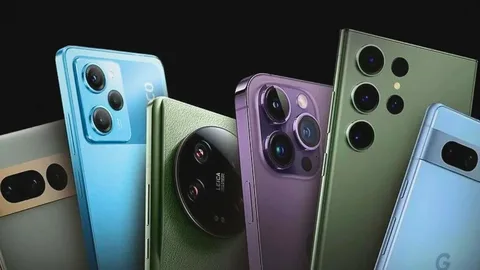

For nearly two decades, the smartphone has been the undisputed sun around which our digital lives revolve. Since the debut of the original iPhone in 2007, the “rectangular slab” has replaced our cameras, maps, wallets, and even our social lives. However, we have reached a plateau. Innovation in the smartphone market has become incremental—a slightly faster chip, a marginally better camera, or a fold in the screen.
Today, the world’s most powerful tech giants—Apple, Meta, Google, and Microsoft—are quietly preparing for a world where the smartphone is no longer the primary interface. This transition into the post-smartphone era is not just about a new gadget; it is about a fundamental shift toward Spatial Computing, Ambient Intelligence, and Agentic AI.
The evolution of mobile devices is part of a much larger technology transformation that is redefining how we interact with the digital world.
1. The Smartphone Plateau: Why the Rectangular Slab is Fading
The primary reason tech giants are looking beyond the smartphone is market saturation. Global smartphone replacement cycles have lengthened significantly. Consumers are no longer rushing to upgrade every year because the hardware has “peaked.”
Furthermore, the smartphone is fundamentally intrusive. It requires us to look down, away from the world, and into a glowing glass box. The future, according to tech visionaries, is heads-up and hands-free. The goal is to move technology from our pockets into the environment around us.
+1
2. Spatial Computing: Merging the Digital and Physical Realms
Apple’s entry into this field with the Vision Pro marked the official birth of Spatial Computing. Unlike traditional Virtual Reality (VR), which cuts you off from the world, Spatial Computing overlays digital information onto the physical environment.
+1
The Apple Vision
Apple’s vision is not to replace the Mac or the iPhone overnight but to create a “seamless ecosystem.” Imagine sitting at a physical desk while three massive virtual monitors float in the air before you. You control them not with a mouse, but with a simple glance or a pinch of your fingers. This is the transition from a 2D interface to a 3D experience.
Meta’s Quest for the Metaverse
While Apple focuses on productivity and “Presence,” Meta (formerly Facebook) is doubling down on the social fabric of the Metaverse. Mark Zuckerberg’s recent unveiling of Orion—highly advanced AR glasses prototypes—suggests that the ultimate goal is a device that looks like regular spectacles but can project high-fidelity holograms for gaming, remote work, and social interaction.
3. The Eyes Have It: The Resurgence of Smart Glasses
If the Vision Pro is the “heavy lifter” of the new era, Smart Glasses are the daily drivers. The collaboration between Meta and Ray-Ban has proven that consumers are willing to wear technology on their faces if it looks stylish and offers utility.
From Scrolling to Looking
In the post-smartphone world, “looking” becomes the new “scrolling.” With built-in cameras and AI, smart glasses can:
- Translate signs in real-time as you walk through a foreign city.
- Identify plants or landmarks just by glancing at them.
- Provide turn-by-turn navigation via small prisms or holographic displays.
Google is also re-entering the ring with Project Astra, a multimodal AI agent that can “see” through your glasses and answer questions about the world in real-time. This is the evolution of the “Google Glass” concept, refined by a decade of AI progress.
4. From Tools to Teammates: The Era of Agentic AI
The biggest catalyst for the post-smartphone world isn’t a screen; it’s Artificial Intelligence. Specifically, the shift from Generative AI (which writes text or makes images) to Agentic AI (which takes action).
Current smartphones are “reactive”—you open an app to do a task. Future AI agents will be “proactive.” They will live in the cloud and interact with you through various hardware—your glasses, your watch, or your home’s ambient speakers. These agents won’t just tell you when your flight is; they will automatically rebook it, message your Uber driver, and update your hotel reservation when they detect a delay.
+1
5. Ambient Intelligence: The Technology of the Invisible
Ambient Intelligence (AmI) refers to electronic environments that are sensitive and responsive to the presence of people. In this vision, technology fades into the architecture of our lives.
Imagine a home where the walls, mirrors, and tabletops are the interfaces.
- Microsoft is focusing on enterprise-grade “Holographic AI” for industrial training.
- Amazon is integrating Alexa deeper into the physical home, moving toward a “Star Trek” computer model where you simply speak to the room to get things done.
In an ambient world, you don’t “go” to a device. The intelligence is already there, waiting for your voice, gesture, or even your gaze.
6. The Body as the Interface: Wearables and Bio-integration
The smartphone is an external tool. The future is internal and “on-body.”
- Smart Rings: Devices like the Oura Ring or Samsung Galaxy Ring are moving health tracking from the wrist to a more discreet form factor.
- Haptic Wearables: Scientists are developing “skin” interfaces that allow you to “feel” digital objects through vibrations and pressure.
- Smart Hearables: AirPods and other earbuds are evolving into “all-day” computers that provide audio-based AI assistance, filtering out noise or translating speech instantly.
7. Neuralink and BCI: The Final Hardware Frontier
The ultimate “beyond smartphone” technology is the Brain-Computer Interface (BCI). Elon Musk’s Neuralink and competitors like Synchron are working on chips that allow humans to control digital devices directly with their thoughts.
+1
While currently focused on medical applications—such as helping paralyzed individuals move cursors or type—the long-term vision is “human-AI symbiosis.” If you can think a command and have it executed, the need for a handheld screen vanishes entirely. This represents the absolute end-point of hardware: the hardware becomes us.
8. The 6G Backbone: Powering a World Without Latency
For a world filled with AR glasses and AI agents to work, the infrastructure must be flawless. 6G technology is currently being designed to provide the ultra-low latency required for “instant” digital overlays. While 5G brought speed, 6G will bring “spatial awareness,” allowing billions of sensors to communicate in real-time. This will enable Digital Twins—real-time digital replicas of entire cities—allowing AI to navigate and manage physical spaces with precision.
9. Ethical Quagmires: Privacy in an Always-On World
A future beyond smartphones is not without its “black mirror” moments.
- Constant Surveillance: If everyone is wearing AR glasses with cameras, the concept of public privacy effectively disappears.
- Data Sovereignty: When our thoughts (via BCI) or our biometrics (via wearables) are being processed by tech giants, who owns that data?
- Digital Divide: As technology becomes more integrated into the human body and environment, the gap between those who can afford “augmentation” and those who cannot will grow.
10. Conclusion: The Hybrid Decade
We are currently in a transition period. For the next 5 to 10 years, the smartphone will remain our “hub,” but its importance will wane as it begins to function more like a brain for our peripherals. We will see a shift from “mobile-first” to “AI-first” and “spatial-first.”
The tech giants are no longer building better phones; they are building the Operating System for Reality. Whether it is through a lens on our face, a chip in our ear, or an agent in our home, the future of technology is moving out of the palm of our hands and into the very air we breathe.
Future smartphones will prioritize efficiency, making it easier to integrate smart tools like Sinkom into our daily workflows without the need for constant manual input.